Search This Blog

Saturday, February 1, 2025

Russell's Round-the-World Tour


Guest post by Liam C.

Part 1 of 2

     Many readers of this blog who are interested in Bible Student History and who like me spend too much time on the internet, may have come across a series of photos related to the I.B.S.A. Foreign Mission Investigation and World Tour. What is the story behind these photos? Below is my best attempt at answering this question.

     The photos are held at the Library of Congress in the George Grantham Bain Collection. George Grantham Bain was a New York photographer who also founded the first news photography service, Bain News, in 1898. He was:

     “A visionary who saw the potential of coupling photographs with words in newspapers and magazines, his news photo service focused on people and events, from politics to sports, disasters to celebrations. The Bain News Service accumulated photographs of worldwide coverage, which were distributed to various newspapers and were enhanced by receiving local pictures from its subscribers as part of their reimbursement” (i).

     The Library of Congress purchased the Bain collection in 1948 from D.J. Culver and thankfully made them available with no known restrictions on publication. Included in the Bain photographs are 39,744 glass negatives three of which are below:


     Although exactly how the Russell photographs came to be acquired by Bain is unknown, the fact that they are included in such a prestigious collection is perhaps a testament to Russell's popularity at the time and the widespread appeal of the Bible Student message.

     Photos in the Bain collection do not include much background information. However a bit of detective work actually reveals when and where the Russell photos were taken. In the margins of two of the above photos is the date (shown as 9/25/11 in reverse). The significance of this date can be found in the below extract from the January 1, 1912 Watch Tower, an issue entirely dedicated to publicising the world tour. Speaking of events in the year 1911 it says:


     By further comparing details from these photos with pictures of the original Waldorf Astoria's famed rooftop garden, it is almost certain that this is where these photos were taken. I have written to the Waldorf Astoria archives and can update this post if any additional information turns up.

     It’s kinda cool to envision that meeting, surrounded by the elegance of the Waldorf Astoria’s rooftop, with Russell and company laying out the blueprint for what would become an unforgettable four-month global expedition.

     What else can be known about the background of this legendary Round-the-World Tour? Read part 2.


Part 2 of 2

     A deeper dive into Russell’s Round-the-World Tour should probably start with a brief discussion of the Layman’s Missionary Movement and the Protestant missionary fields in the last few decades of the nineteenth century which at the time were filled with confidence and optimism.

     The Evangelization of the World in this Generation by John R. Mott, page 1 & 2 describes how in 1886 a movement arose among students primarily in the United States, Canada, Great Britain and Ireland that would eventually be attributed with adding 20,000 volunteers to the foreign missionary endeavour, therefore accelerating missionary work around the world. This movement called the Student Volunteer Movement (SVM) inspired Protestant leaders to create institutions to offer financial support.

     One of these institutions was the Layman’s Missionary Movement (LMM). Between the years 1909-1910 The LMM arranged a series of three to four day conventions held in more then 50 cities averaging well over 1,000 in attendance. While the students of the SVM had adopted the slogan “The Evangelization of the World in this Generation”, The LMM took this further and advertised their conventions with the slogan “$30,000,000 to Convert the World” (ii) & (iii)

     This slogan caught Russell’s attention. Russell was somewhat sympathetic to the missionary cause and even once recalled how as a boy of seven years of age he told his mother that he wanted to be a missionary (iv). As he developed the unique interpretation of scripture known to readers of this blog, his missionary aspirations were adjusted to fit his overall understanding of God’s plan as revealed in scripture. Part of this understanding was that the mainstream Christianity of his day was not a model of Christ’s kingdom but had been judged unworthy of it. Therefore converting people of non-Christian lands to this form of Christianity would be counterproductive. He pointed out that doctrines such as the conviction that there is no hope for any who die in ignorance of the only name whereby we must be saved” (v). when thought through, were abhorrent to people of non-Christian backgrounds, as they offered no hope for their ancestors or family members that had not accepted Christ. He further saw in the Scriptures a future age following Christ’s Advent, where all who died in ignorance of Christ would be given another chance, without question a more hopeful view. Russell’s criticism of mission work included the observation that missionary successes were often overstated and that behavior of people in “Christian” lands was anything but Christian while non-Christian peoples were more moral than supposed.

     Russell’s response to the Layman’s Missionary Movement came in July 1911 with the article “$30,000,000 to Convert the World is the Proposition a Joke?” (vi). In this article Russell references the LMM and lays out his criticism of mission work, contrasting it with the early successes of his own missionaries in India and Africa. But he didn't stop there. Several months later at the annual Bible Students convention at Mountain Lake Park, Maryland, September 1-11, 1911 a committee was formed to supply an unvarnished report of the true condition of affairs in Oriental lands amongst the peoples usually termed heathens”.(vii). This was followed on September 25 by the committees first meeting at the Waldorf Astoria as discussed in Part 1. This committee was named the I.B.S.A. Foreign Mission Investigation Committee.

     To be sure, one goal of this tour and subsequent report was to assess the feasibility of the claim made by the LMM. Russell had other reasons for travelling to foreign mission fields at this time though. One of the conclusions drawn from the framework by which he saw the Bible’s message was that during the unique time period him and like minded Bible students were living through, they were tasked with gathering from the churches of nominal Christianity any remaining saints, a responsibility which they worked diligently to accomplish. But what of the growing number of Christians living in traditionally non-Christian lands that due to distance or language barriers had not heard the Bible Student message? Seeing conditions first hand would help him decide whether directing further resources there was warranted.

     The  I.B.S.A. Foreign Mission Investigation Committee would come to include chairman Charles Taze Russell, secretary Fredrick Homer Robison/Robinson (called Professor). Doctor Leslie Whitney Jones (1872-1946), Adjutant General of the United States Army, William Preble Hall (1848-1927), Washington D.C., grocery store chain owner John Donaldson Pyles (1857-1943) and two well known Ohio businessmen Robert Bowie Maxwell (1840-1912) of Mansfield and Ernest W.V. Kuehn (1863-1925) of Toledo, whose business dealings earned him the moniker “great clover-seed merchant”. Also added were unofficial members Ingram I. Margeson (1871-1935) who acted as director, George F. Wilson (1857-1945) and wife Olivia E. Wilson (1864-1957) of Oklahoma City and George Chester Driscoll, who for the first half of the trip traveled several weeks ahead of the group to assist with press and any other arrangements that needed to be made.

Foreign Mission Investigation Committee (minus G C Driscoll) pictured with a group of Japanese gentlemen associated with the Japan Y.M.C.A. including Kuninosuke Yamamoto (back row far right). Picture from 1912 Bible Students' Convention Souvenir Notes, page 22. 

     Further details about the tour can be found in the 1912 Bible Students’ Conventions Souvenir Notes and the Committee Report published in the Watch Tower April 15, 1912.


End notes

i "George Grantham Bain," Legends of America, accessed January 28, 2025, https://www.legendsofamerica.com/george-grantham-bain/

[ii] A more detailed discussion of the SVM and LMM can be found in Dawson, David. Mission and Money in the Early Twentieth Century.The Journal of Presbyterian History (1997-) 80, no. 1 (2002): 29–42. http://www.jstor.org/stable/23336304.

[iii] An example can be found in the New York Times December, 13, 1909

[iv] Zions Watch Tower, June 15, 1899 page 2489

[v] Zions Watch Tower August 15, 1901, page 264

[vi] The Watch Tower, July 1, 1911, page 202-204

[vii] Report on Foreign Mission Work, International Bible Students Association, April 15, 1912, page 123


Thursday, January 30, 2025

Photo Drama Card

 My thanks to Tom S. who sent this photo to me.


Peoples' Temple, Los Angeles, California, Courtesy of Tom S.


Tuesday, January 28, 2025

Saturday, January 25, 2025

Translation Help

 Please translate this card.


Local Convention 1921

 Tom S. sent me a mass of material for which I am very thankful. This is a handbill for a local convention. There were many of these in the 1920s; they're mentioned and described in some detail in The New Era Enterprise

The Gamut Club

Front

 Reverse

Tom S. has a long history with the Watchtower Society as did his father before him. I wish more would contribute material to my blog and by all means consider donating to the Society's museum collection. Follow the instructions if you decide to do that. Contact them first.

Tuesday, January 21, 2025

Ready for Work

 This photo is for sale on ebay. It is, of course, way past the era we cover here, but it is interesting. The brothers and sisters and children stand outside a Kingdom Hall in a rented store front. I remember meeting in rented space before we built our first Kingdom Hall. Comments and thoughts are welcome.


Another photo from the same ebay group, showing a sister with her phonograph. It was taken in St. Helens, Oregon.


Tuesday, January 14, 2025

We get comments...


This blog invites comments on historical matters, but sometimes receives responses of a highly negative nature. These normally just get deleted; people who want to criticise or debate can no doubt find homes elsewhere. But a recent comment on an old post that I wrote back in 2012 prompted this post. It is to clarify a couple of things that crop up from time to time related to Joseph Lytle Russell and Emma Ackley and their marriage.

    I am not going into great detail – researchers can check matters out for themselves and most points have already been covered in the past on this blog.

    The post is:

    https://truthhistory.blogspot.com/2012/02/marriage-of-joseph-lytel-russell-and.html

    It establishes that over a year after CTR and Maria married, JLR and Emma were still single but living in the Russell household. The census return for their street, Cedar Avenue, is dated June 14, 1880.

    There are four occupants of the house, C T Russel (sic), married, occupation: merchant; Maria F, married, wife, keeps house; J L, widowed, father, occupation: merchant; and E H Ackley, single, sister (step), occupation: at home.

    (The relationship entry for Emma in the schedule is incorrect. Her relationship to the head of the household at this time is sister-in-law.)

    The issues raised in the comment are basically threefold.

1.      Did Joseph and Emma ever marry?

2.      What was going on in that house with four of them there?

3.      The difference in ages between Joseph and Emma.

    The comment starts with: “I’m good at genealogical investigations and I cannot find any record that indicates that Joseph Russell and Emma Ackley married.”

    I would agree there is no apparent record. But there is a good reason for that. The State of Pennyslvania did not require marriages to be officially registered until 1885, and “common law” marriages continued to be “common” for years thereafter. If you married before then, generally your immediately family would know, but no-one else would unless you put it in the newspaper or had legal matters to attend to. If you wanted a “quiet” wedding, it really was quiet.

    To illustrate the situation, perhaps readers can find an official document for CTR and Maria’s marriage? Like Joseph and Emma’s, it is not there. But we know about them because they chose to put an announcement in the local paper and CTR was sufficiently well known in Allegheny for it to make a short paragraph in the papers. Both the Pittsburgh Gazette and Pittsburgh Post (March 14, 1879) carry news of the marriage at the home of Maria’s mother the day before with J H Paton officiating.

    As an aside, this lack of documentation did not just apply to marriages. You will not find a primary source for J F Rutherford’s birth. When he needed to renew a passport, his mother Lenora, had to extract a reference from a family Bible and sign an affidavit to that effect. There were no other records extant.

    Returning to Emma, when it came to JLR’s last will and testament, part was disputed by Emma who believed that as his wife she should have inherited more. In all the legal documents on the case he is the husband and she is the wife. Joseph’s obituary found in several newspapers calls her his wife. You can check the details if you are so minded.

    The second criticism is that it was strange for the four to all be in the same house. The writer makes all manner of salacious accusations against both Joseph L and Charles T in that same household, without a shred of evidence.

    I am not going to even dignify this with comments, other than to say that I see no problem with the four people living under the same roof in the snapshot of June 1880 for Cedar Avenue. I’ve visited the Cedar Avenue houses. They are large. Years later Maria was able to take in a number of lodgers in one.

    Why were they in the same home? Well, why not? CTR and Maria were close at this time, committed to their religious work. Emma and Maria were very close and would spend the last decades of their lives together. CTR and his father Joseph were very close. There would be nothing surprising about them being under the same roof at some point, and that may even have led to the two unattached becoming a married couple. As already noted the house in Cedar Avenue was large with plenty of space.

    We do not know how long they were all at the same address. The census is a snapshot of one day, June 14, but one can assume that any marriage came quite soon after that date since Emma’s daughter Mabel appears to have been conceived around December that year.

    The December date comes from Mabel’s birth date in September 1881, and that can be confirmed from her marriage certificate when she married Richard Packard in 1903. It gives her birth date as September 1881 but does not give the actual day. If she was born in September 1881, then obviously she was conceived around December 1880. That would be 5-6 months after she and Joseph were living under CTR’s roof while both single. That gives us a window of a few months for a marriage.

    We might here note that to try and bolster the slurs made against Charles and Joseph, the writer comments on the period June-December 1880 with the statement: “That does not leave a lot of time for the two (Joseph and Emma) to fall madly in love and wed.” What sort of logic is that? Who is to say they didn’t “fall in love” some time before the census, and were at the same address on census night planning the wedding for the following week? We just don’t know. We certanly have no basis for filling in the gaps to support an obvious negative program.

    When married, and after a baby came along it would make more sense for them all to look for separate homes, but even then, they were near each other until Joseph, Emma and Mabel went to Florida.

    The suggestion that there was something bad about all of this is a large leap of imagination with an obvious agenda. They were all close at the time. It is very sad what happened later.

    The third criticism that is dredged up yet again is the disparity in ages. Why would a woman in her 20s want to marry a man in his 60s?

    Don’t be too critical about other people’s decisions.  Just look around in the world of entertainment and politics, the same thing occurs today. As it happens, the same has happened in my own extended family. But back in the 1880s an obvious reason for a woman was to be provided with stablity and financial security. That is something I venture the Ackley girls were always concerned about by their later actions. And as a potential bonus, Emma was able to have a child, which may have been very important to her.

    So, whoever wrote the comment, please leave the sordid speculation alone. And if you can’t do that, just don’t send it here.


Wednesday, January 8, 2025

Help!

 I need help with my young adult book. The text is done, but I can't seem to create my cover. I want to use a previous cover, one used on a rough draft printout. But nothing is working for me, probably because I'm currently on very potent prescriptions.

Any volunteers?

The issue has been resolved. Thanks


Wednesday, January 1, 2025

Talk Invitation c. 1920-22

 Currently on ebay. No I do not profit from this. It's just interesting.


Wednesday, December 25, 2024

Russell's Newspaper Sermons

 Newspapers started carrying Russell's sermons in 1903. I won't discuss all the issues surrounding this enterprise, but it is interesting that The Homiletic Review of May 1903 recommended one as presenting a topic other clergy might want to use.


Tuesday, December 24, 2024

Appointed Times of the Nations [Gentile Times]

 This, with an American publication from the same year, is the earliest mention of 2520 years as the length of the Gentile Times. This 1798 booklet is in the British Museum collection.


Friday, December 20, 2024

IBSA Postcard - 1918

Currently on ebay. I've not seen this before.


John Corbin Sunderlin

 A man of many facets, he was a Methodist clergyman, a Civil War Veteran, a well-known and respected photographer, one of the first contributors to Zion's Watch Tower. These are three of his photographs from the 1880s. Note that the child in the dress is a boy; short dresses and pants were the norm for very young boys in that period. There is no known connection to Watch Tower adherents.


Wednesday, December 18, 2024

Allegheny City

 A challenge. Can you relate these views of the city to Watch Tower history in the Russell era?

The flood of 1874. 
Allegheny City was subject to periodic flooding which found a place in fiction. For realistic details read Mary Roberts Rinehart's The Case of Jenny Brice.

The Carnegie Library 

Sunday, December 15, 2024

“Angels and Women”, Problems from beyond?


Guest post by Chris G.

Published in 1924 this book was purported to be a favorite read of Charles Taze Russell.  The book was not published in any official capacity by the Watchtower and Bible Tract Society but was endorsed in the pages of the “Golden Age” magazine (see g24 7/30; g24 12/3).  The Golden Age articles also gave the contact information of how to attain this book if one desired. 

            Among archivists of Watchtower publications, this work has found itself among the list of books that contribute to a complete library.   It has a kind of honorary place among the well known “Studies in the Scriptures” and the early writing of Judge J.F. Rutherford such as the “Harp of God” and perhaps “Deliverance”. 

            Due to this quasi official status, it has come under fire for having confusing statements in its “forward” as written by the books publisher.  We will discuss this and why these words are controversial to some, and how we can understand them more clearly through the clarity of time.

A brief history!

            Angels and Women was a reprint of a much earlier work named “Seola” published in 1878 and written by Ann Eliza Smith, or as known by many, Mrs. J. Gregory Smith of St. Albans, VT. 

            Seola tells the story of the pre flood world and the struggles that may have been present based on the limited story as outlined in the Holy Bible’s account of Genesis chapter 6.  In Seola, it dramatically portrays the difficulty of navigating a world where supermen have appeared from the heavens and demanded power, wealth and wives, as many as they wanted, from among pitiable humans at that time.  All based loosely on the flood account of Genesis, it’s a fascinating read, and it’s no wonder that bible students of the day were impressed by its contents.  After reading the book I found it encouraging and enlightening to imagine what “might have” happened in those days.  I never thought of the book as being controversial, but I’m getting ahead of myself.

            Fast forward to the mid 1920s and the original work of Seola was likely becoming hard to find as it had long been out of print.  No doubt some talk of it had spread among the early bible students associated with Russell and a desire to read it was likely a fact of the few thousand bible students at that time.  It seemed like a good idea when, a somewhat well known bible student by the name of E.W. Brenneisen (misspelled Brenisen frequently) decided to republish the original novel with some minor updates that would include footnotes including those from current and previous Watchtower publications.

In order to publish this revision, a book company by the name of the A. B. ABAC Company of NY appears to have been created.  I’ve never been able to find any other titles published by this specific company in twenty years of looking so it appears this company was created with the sole purpose of bringing Seola back to life.

All the facts that are about to follow are simply taken from the forward of this book and used to explain what would become a drama of sorts for the readers of that time that has continued down to this day.

…by way of explanation

The three page foreword of Angels and Women appears to have caused all the concerns and seems to be the source of the controversy.  I’ll quote a few of the thoughts below and you’ll see what I mean.

“Since the flood these evil angels have had no power to materialize, yet they have had the power and exercised it, of communicating with human beings through willing dupes known as spirit mediums.”,

And then comes the smoking gun comment that’s caused so much interest among critics of this book.

“The reviser of this book is of the opinion (italics mine) that the original manuscript was dictated to the woman who wrote it by one of the fallen angels who desired to return to divine favor.”   (https://archive.org/details/angelswomenrevis0000jgre/page/4/mode/2up)

What in the world?

So the “reviser” was of the opinion, yes opinion that the original author was handed/transmitted this information from “fallen angels” or “good” fallen angels that were somehow trying to assist good hearted humans into winning the battle against the dark forces that would become so effective and prevalent in the last days.  The battle would be difficult and this book was made to help the reader see the tactics of Satan and his cohorts.  As the book’s forward concludes it clarifies its purpose, “Spiritism, otherwise named demonism, is working great evil amongst men.  It should be studiously avoided.  To be forewarned is to be forearmed.  Hence this publication”

What in the world was the publisher thinking?  Well, it’s easy from our current vantage point to think negatively of the perspective of E.W. Brenneisen who at the time was reflecting a fairly accepted theology of his day.  The belief among some Protestants of that time was that there were good angels and there were bad fallen angels but in the second category there were two classes of fallen angels.  Those who were dead set against the will of their creator and those that were repentant and trying to find their way back to the good graces of Jehovah.

This thought was believed commonly among early bible students of the Watchtower and Bible Tract Society and the following references can be checked to confirm this belief through the mid 1940s as far as my research was able to reveal.  (see w23 p133 par 56; w43 4/15 p123 par 9; g44 6/21 p17 par 2; w45 8/1 p229 par 13)

The “two classes” of fallen angels appears to have been a belief based on a scriptural passage found at 1 Peter 3:19-20 that at first glance appears to fully support this.  However in the Watchtower of 1951, November 15 issue, a Question from Readers was expounded on that began the foundation of the current theology that expresses no room for a change of circumstance for any fallen Angels or demons as we commonly refer to them.  The “two classes” way of thinking as applied to these demons was expunged and logically explained to be a faulty way of looking at that passage.  From this point forward it’s been hard to imagine any place of acceptance for the Publishers words in the foreword of Angels and Women, and yet, there they were.

A Closer look!

            Let’s simply examine one word of the publisher above in italics.  He states, “The reviser of this book is of the opinion that the original manuscript was dictated to the woman who wrote it by one of the fallen angels…”  He was simply of the “opinion” that this was the case.  That is very different than saying something is a verifiable fact or truth of some kind that can never be reversed or disagreed with.  I think that point stands all on its own.  We all have opinions and our opinions are subject to change at any point based on more facts coming to light.  If the reviser quoted above had republished Angels and Women in the mid 1950’s after reading the Question from Readers article of November 15, 1951 he may have subsequently changed his “opinion” and the foreword itself may have been revised if any future editions of Angels and Women were made. 

            So it may be a little easier to understand why the Golden Age magazine, an official magazine published by the Watchtower Bible & Tract Society at the time, would have advertised this outside work for Christian study at the time.  However the question remains, was this book actually believed by the original author to have been transmitted to her by a good fallen angel?

Mrs. J. G. Smith in her own words!

            Much of the controversy surrounding Angels and Women appears to have begun likely sometime in the last 30-40 years.  Some strong opinions denouncing the book admit that there were no original copies of “Seola” to reference or use as a comparison when reviewing Angels and Women and forming their own negative opinions of it.

            This is unfortunately a grave error on the part of those who chose to speak so harshly of a revision of a book some 45 or more years removed from the original work.  If the critics would have taken the time to review the original author's own words in regards to the Seola novel, much, or all, of the controversy sparked would have been extinguished.

            Seola was masterfully written!  I am of the opinion that it’s close to being riveting as a book.  Like many movies, dramas or books, it begins with a bang.  The novel starts and sets the stage by making the reader think they are possibly reading something of fact.  The author takes creative license here to absorb the reader into her created world.  If you read from the beginning of the book it’s a little bit confusing as to whether the author believes the material as fact or not.  It’s part of the journey of reading the work that makes it so compelling and enjoyable. 

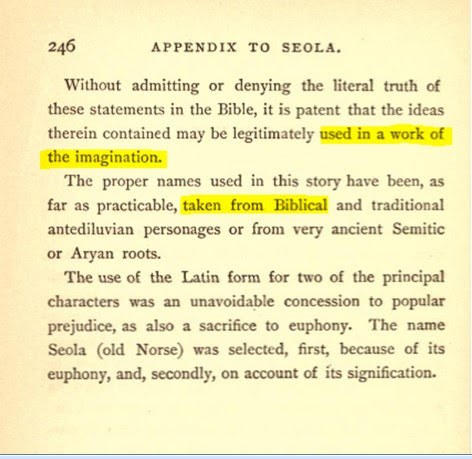
            However, and likely out of a sense of professional responsibility, she makes clear in the Appendix of the original Seola some points that put the whole issue here at rest.  Let’s take a look.  (https://archive.org/details/seolaxxx00smitiala/page/246/mode/2up)

Starting on page 238 the “Appendix to Seola” begins the testimony of the authoress on her creative process.  So as not to ruin the novel itself and show perhaps what’s behind the curtain, it’s reasonable to see why this is at the back of the book.  I’ve included screen shots below so you can see for yourself her explanation, but her opening words say much of what needs to be said.  “SEOLA is a fantasy”.


I don’t typically place entire Appendixes in articles but in this case I think it’s of the utmost importance for the discriminating reader to determine logically and reasonably what the author’s true intent was in writing this book.  Mrs. Smith appears to have been a keen student of the Bible as many were in those days when a study of the Holy Bible was as important as reading your hometown newspaper everyday may have been.  Her other novels, or at least one of them, appears to have basis on a deep understanding of the scriptures also.  I’m referring to “From Dawn to Sunrise”, see below, but that’s a subject for another article.

The first paragraph states clearly that, “Seola is a fantasy, revealed to the writer while listening to the performance of an extraordinary musical composition”.  She was simply inspired while listening to music.  Does that sound familiar to you?  It probably should because many creative people get their inspiration from many things, but music is an ingredient for many to open their minds in an innocent way.  She says nothing about hearing voices or speaking with the “angels” in any way.  To interpolate that thinking is to be deceitful in the light of facts.  I’ve highlighted a couple points but suffice it to say I think Mrs. J. G. Smith does a good job of explaining away any mystery that she may have created in her well written novel.  And that’s simply all it is, a novel.  It’s good reading, hopefully of the encouraging type, that leaves one smiling after enjoying the ride.

            So is Angels and Women a “Problem from beyond?” like a black sheep of our literary past we should shun and not talk about?  An embarrassment to be ignored?  I don’t think so, but like many complex arguments or opposing opinions to our theocratic heritage, it takes a closer look to reveal the facts.  And by doing that our thoughts are made more sure and we hopefully learn something along the way.  Thank you Mrs. J. G. Smith, for your creative effort all those years ago. 


Saturday, December 7, 2024

Grave Matters


A new book has recently been published on the United Cemeteries, entitled GRAVE MATTERS. It is 170 pages and fully illustrated.


Some of the research first appeared on this blog over a decade ago. Details of the book can be found on the Lulu site. Just visit Lulu Books, and specify LULU BOOKSTORE. The usual URL is: https://www.lulu.com/shop

Then in the search box type in GRAVE MATTERS. Just be careful because several other writers have used this title, but it should be obvious which one is the history book, with its pale blue cover (above) and description.

The blurb for the book is as follows:

The unusual story of the Watch Tower Society's own graveyard in Ross Township. Originally 90 acres, now just a small area remains associated with Watch Tower, including the grave of Charles Taze Russell. The account includes Russell's funeral, the tale of his sister who is buried alongside him, the Miracle Wheat episode (which was grown on site) and the background of the names engraved on the sides of a pyramid monument in the center of the site until recent years. Also, the strange story of "treasure" buried in the pyramid back in 1920 and what happened to it? Who would have thought that a small piece of land just 64 feet square would provide so much history.


Tuesday, December 3, 2024

Convention Dramas

 I'm up and working - sort of. This is my youngest daughter dressed for a drama. I didn't ask permission to post her photo, but she's 32 and probably wont care about a childhood photo.


Monday, December 2, 2024

Brooklyn Academy of Music

 These come from Raymond S., a friend to this blog. The first view is of the building about 1910 and the second is how it looked about 1930. For context see the post "An Invitation." -Annie


"Uncle B"

 Dr. Schulz has respiratory problems and is mostly bound to his chair. He is, he says, behind on many emails and asks that you be patient. He'll get to your email as he can. 

Annie d'iles-Stewart

Friday, November 29, 2024

An invitation


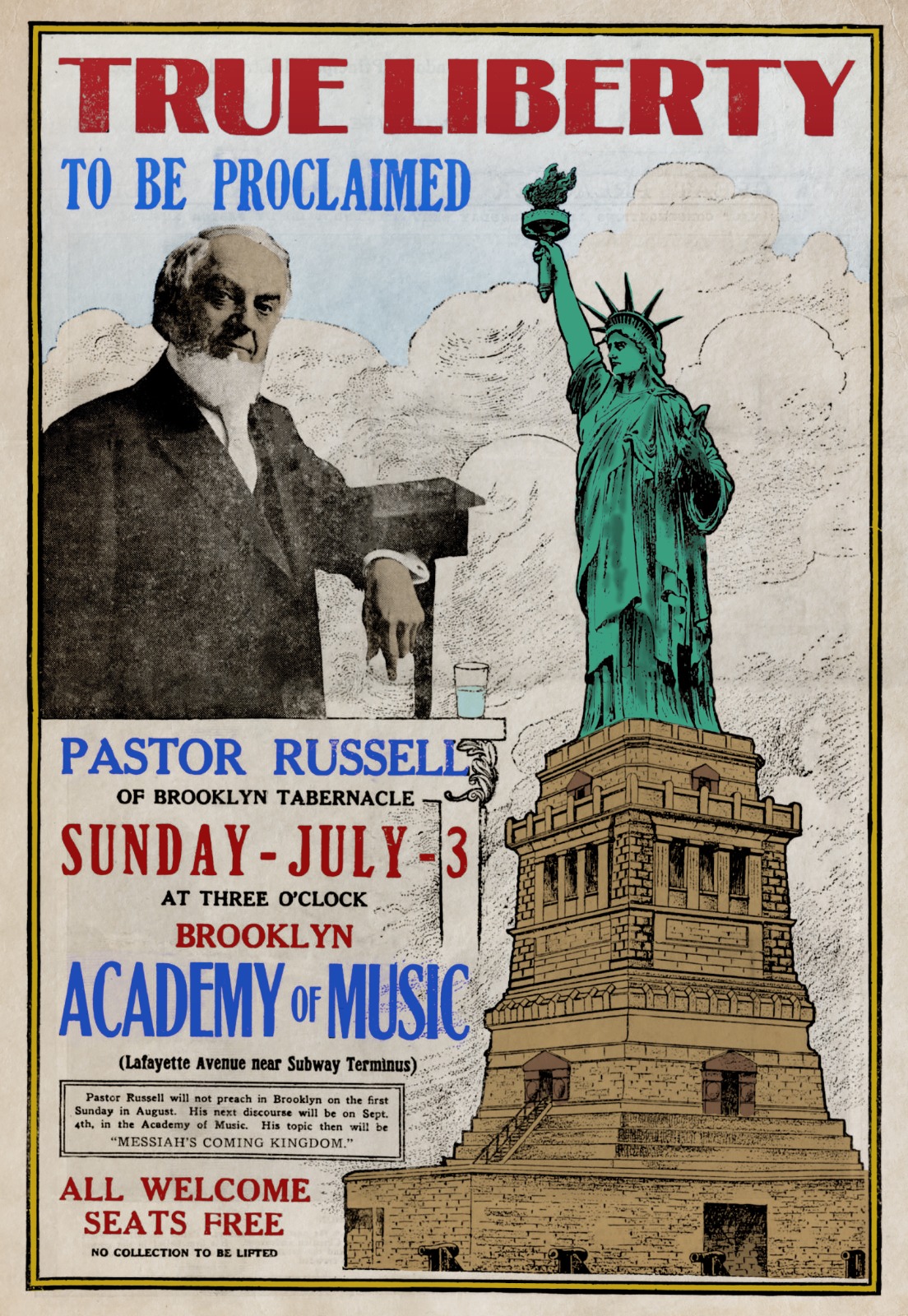
From People’s Pulpit, Volume 2, number 4 (1910). Colorized by Leroy.


Saturday, November 16, 2024

Henry Grew

Grew's Second series of letters to the Rev. E. Lee, on the character of the Son is downloadable from books.google.com

Thursday, November 7, 2024

A Better Scan?

 I need a clean, flat bed scan of this. Anyone?


Wednesday, November 6, 2024

Wednesday, October 23, 2024

J. C. Sunderlin - Newspaper extracts

 From The Manchester, Vermont, Journal, June 22, 1876


The Rutland, Vermont, Weekly Herald, December 18, 1862.


The Lambertville, New Jersey, Record
, December 22, 1886.